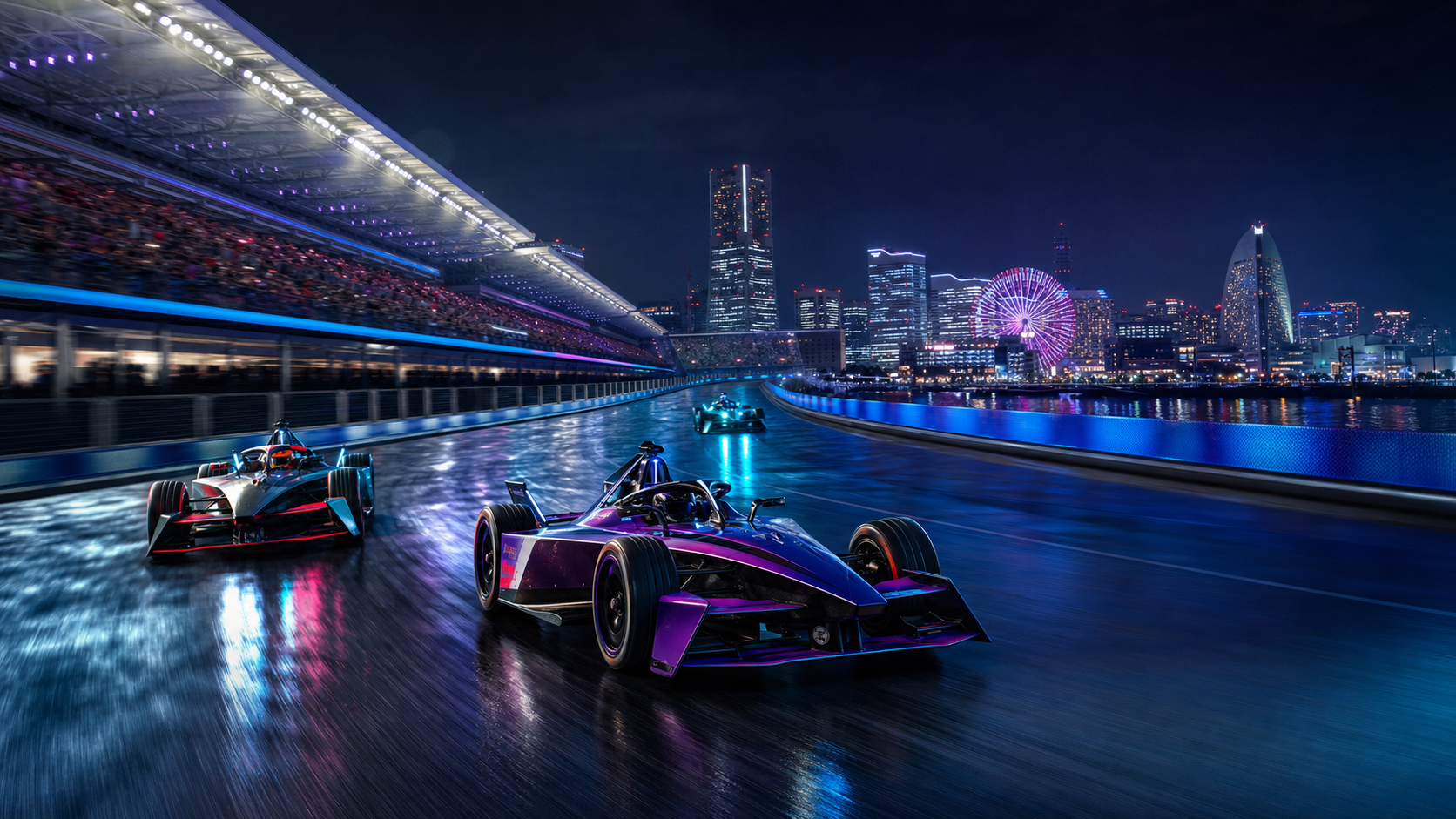
Formula E is staging its first night-race event on the streets of Tokyo this weekend, with championship rounds scheduled for Saturday, July 25, and Sunday, July 26, around the Tokyo Big Sight convention center. The official schedule sets each race for 8:05 p.m. local time, following afternoon practice and qualifying sessions.
The doubleheader is the third edition of the Tokyo E-Prix and arrives with four races remaining in the 2025–26 season. That makes the weekend important both as a new presentation for the event and as a competitive turning point: two races at the same circuit give teams limited time to learn from Saturday before Sunday’s second qualifying session and race.
What makes the event different
Street circuits use public-road surfaces, tight barriers and changing grip rather than the broad runoff areas of permanent tracks. Racing after dark adds another layer. Drivers must process reflections, track lighting and changing temperatures while teams manage energy use across the race. Formula E says the GEN3 Evo cars will compete around the Tokyo Bay waterfront.
Organizers describe the weekend as the first time the all-electric series has raced at night on Japanese streets. The event also connects motorsport with Tokyo’s zero-emission-vehicle program. Formula E said trackside lighting and event operations would be powered with sustainable energy sourced from advanced biofuels, a claim whose full environmental impact depends on the event’s complete energy and transport footprint.
Schedule and how to follow
Saturday practice was listed for 1:30 p.m., qualifying for 3:40 p.m. and the race for 8:05 p.m. local time. Sunday follows the same general pattern, with the second race also at 8:05 p.m. Viewers should use Formula E’s official schedule because broadcast availability and displayed times change by location.
What to watch
Qualifying position matters on a narrow street course, but energy strategy, safety-car timing and overtaking efficiency can reshape the order. The short turnaround also rewards teams that can interpret data quickly. Because this report was prepared during the event weekend, results should be confirmed through Formula E’s live timing and official classification rather than unofficial social posts.
Beyond the spectacle, Tokyo offers a practical test of electric racing in a dense global city: organizers must balance competition, public access, energy demands and the disruption created by a temporary circuit.