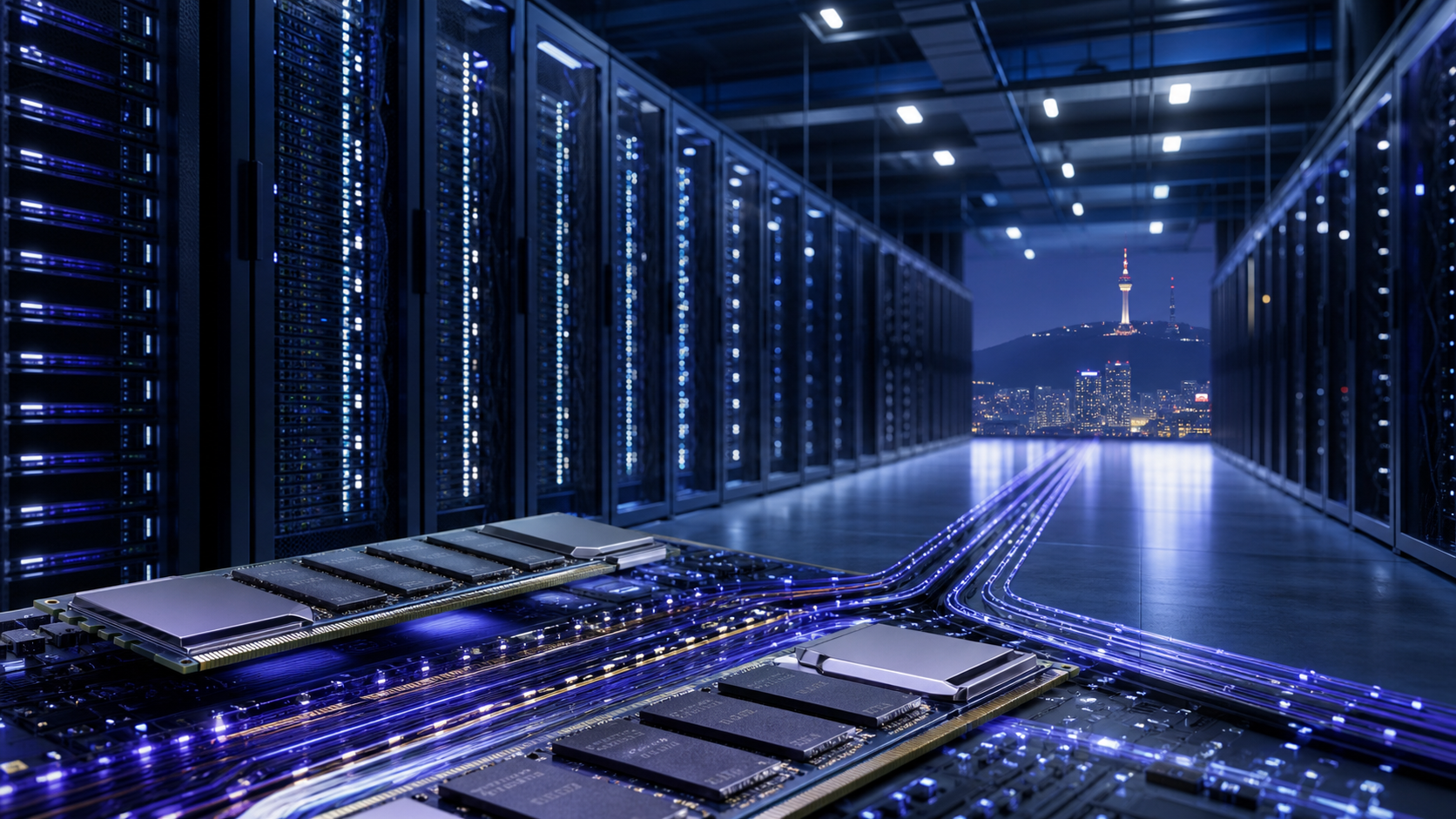
Nvidia and South Korea’s SK Group announced a planned artificial-intelligence initiative valued at more than $500 billion, combining large-scale computing infrastructure with a long-term memory partnership. Nvidia said the companies signed letters of intent covering AI data centers, or “AI factories,” and future high-bandwidth memory supply.
A central element is SK Telecom’s plan for an AI cloud with capacity of up to two gigawatts using Nvidia’s Vera Rubin infrastructure. The companies say the first facility is expected to begin operating in 2027. SK Hynix, meanwhile, is expected to work with Nvidia on supply and co-development of next-generation high-bandwidth memory, a critical component used to move data rapidly to AI accelerators.
Why memory and power matter
AI systems require more than advanced processors. Large clusters need enormous electricity, cooling, networking and specialized memory. High-bandwidth memory has become one of the industry’s most constrained inputs because training and serving large models requires processors to access data with minimal delay. Linking chip architecture with memory development can improve performance but also concentrates supply relationships.
The two-gigawatt figure signals the physical scale under consideration. It describes potential power capacity, not computing output already available today. Construction schedules, grid connections, permitting, financing and customer demand will determine how quickly the announced capacity becomes operational.
An announcement is not completed investment
The headline value covers a broad, long-term initiative. Letters of intent express planned cooperation but are not identical to completed spending or binding purchase orders. Investors and policymakers should distinguish the announced ambition from capital already deployed. Future disclosures should clarify the timetable, ownership structure, financing and environmental impact.
What it means for South Korea
South Korea already occupies a central position in memory-chip production. The initiative could strengthen its role in global AI infrastructure while increasing demand for electricity, construction and engineering. It also raises policy questions about energy supply, water use, local benefits and the resilience of a supply chain tied to a small number of companies.
The next milestones are formal agreements, permits, financing commitments and construction progress. Those measurable steps will show how much of the proposed scale moves from announcement to operation.