
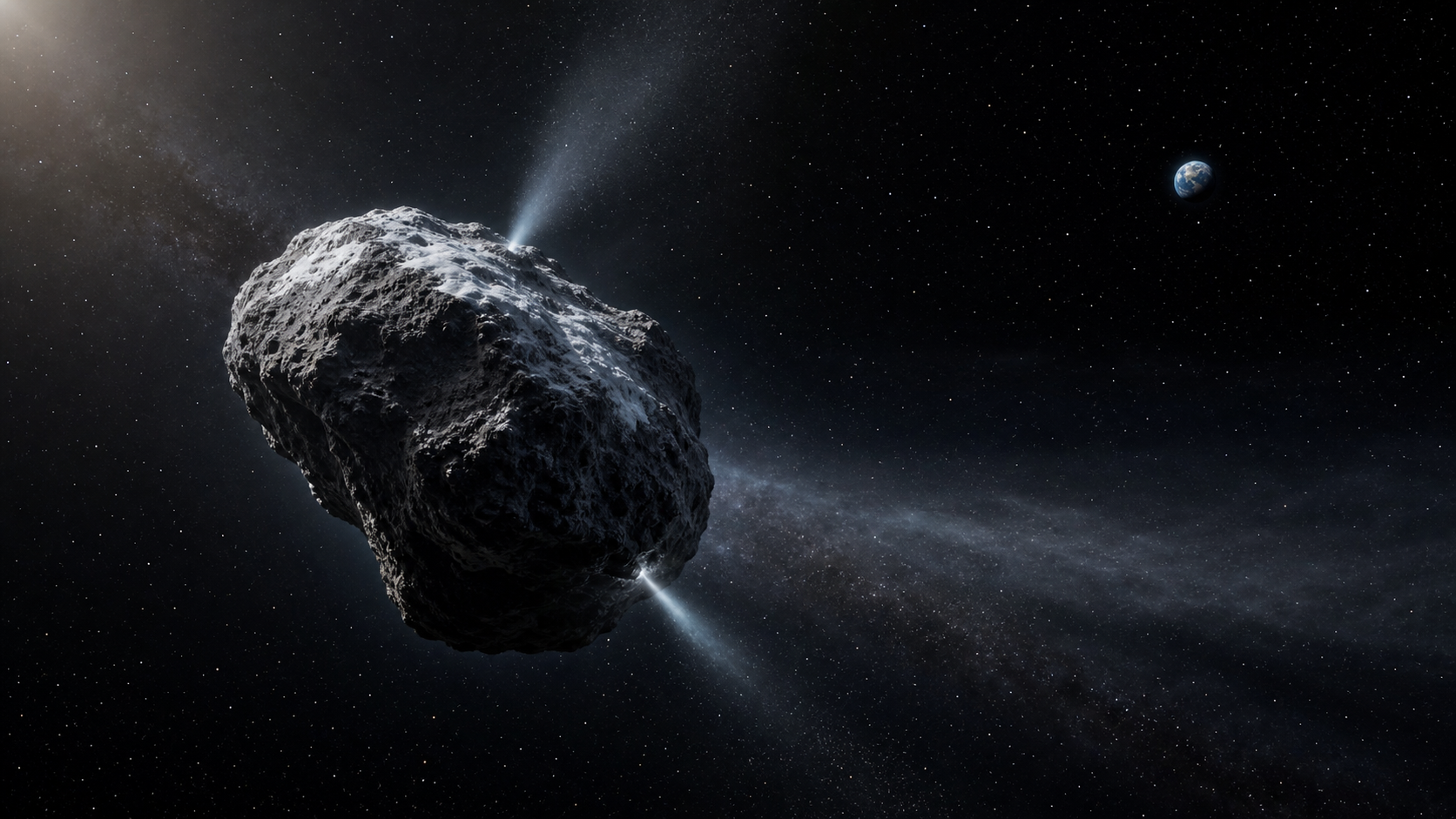
A near-Earth object cataloged as an asteroid for almost three decades has turned out to be an active comet, according to research led by scientists at NASA’s Jet Propulsion Laboratory. The object, first identified in 1998 as 1998 SH2, now also carries the comet designation P/1998 SH2 after astronomers detected a weak tail and explained small but important changes in its path.
The finding is attracting attention because it combines a cosmic mystery with a practical planetary-defense lesson. It does not mean that the object is on a collision course with Earth. NASA says its August 28, 2025 approach was safe, passing about 2 million miles, or 3 million kilometers, from the planet. The important discovery was that the object did not appear exactly where researchers expected it when they tried to observe it with NASA’s Deep Space Network radar.
How an “asteroid” gave itself away
Astronomers predict an object’s position by combining earlier observations with the gravitational influence of the Sun, planets and other bodies. Those calculations had worked for 1998 SH2 during observations made between 1998 and 2016. But after two trips around the Sun without new telescope observations, its 2025 position did not match the prediction closely enough.
The research team examined decades of optical astrometry, the precise measurement of an object’s position against background stars. They found that gravity alone could not fully explain the movement. A small nongravitational force appeared to be nudging the object, which is a signature astronomers often associate with comet activity.
Comets contain ice mixed with rock and dust. As sunlight warms that material, some ice changes directly into gas. Escaping gas can carry dust away and produce a coma and tail, but it can also act like a collection of extremely weak thrusters. Over time, that outgassing can shift a comet away from an orbit calculated using gravity alone.
The telescopes that confirmed the answer
Orbital behavior supplied the clue, but the team still needed visual evidence. Observations were gathered using the Canada-France-Hawaii Telescope in Hawaii, the Danish 1.5-meter telescope at the European Southern Observatory’s La Silla site, and ESO’s Very Large Telescope at Cerro Paranal in Chile.
The powerful instruments revealed a faint but distinct tail. That observation confirmed that 1998 SH2 was not simply a rocky asteroid experiencing an unexplained force. It was releasing material like a comet, even though earlier images had not shown the familiar bright coma and tail people normally associate with comets.
This distinction matters because classification affects how scientists forecast an object’s future motion. An asteroid can usually be modeled mainly through gravity and, for very precise work, smaller effects such as sunlight. An active comet requires researchers to account for changing outgassing as well.
Why this matters for planetary defense
Planetary defense begins with finding near-Earth objects and predicting where they will travel. A hidden comet can complicate that work because small jets may alter its orbit. Detecting those deviations early helps astronomers improve long-term forecasts and avoid treating a comet exactly like an inert asteroid.
The study also connects P/1998 SH2 with the mystery of “dark comets.” These objects show comet-like nongravitational motion but no obvious visible tail, coma or outgassing. NASA reports that roughly a dozen have been identified since the first recognition of the class in 2016. Some larger dark comets may be ordinary but extremely faint comets that reveal themselves only when geometry, timing and telescope sensitivity are favorable.
NASA’s planned NEO Surveyor mission is designed to search in infrared light for difficult-to-detect near-Earth asteroids and comets. Infrared observations can help find dark objects that reflect little visible light. Combined with continuous optical tracking and precise orbit analysis, surveys like this could expose more cases of mistaken identity.
What the discovery does—and does not—show
The result demonstrates the value of revisiting old classifications when new measurements disagree with predictions. It does not show that scientists have suddenly found a new threat, nor does it mean every asteroid is secretly a comet. Instead, it gives researchers another diagnostic: if an object’s motion contains a persistent nongravitational signal, faint outgassing may be responsible.
The research was published in Nature Astronomy, and NASA released its detailed account on July 16. The story gained wider coverage this week because of its unusual “hidden comet” finding. For readers, the most useful takeaway is reassuring: the object passed safely, and the discovery improves the tools scientists use to understand and track the population around Earth.
Sources and method: Solvex News reviewed NASA/JPL’s July 16 report and the linked Nature Astronomy study. Distances have been presented in both miles and kilometers, and the illustration accompanying this article is an AI-generated editorial visualization, not an observation of P/1998 SH2.